checklist
What should be on my checklist the week before we travel to an out of state meet?
Entries, waivers, medical forms, hotel blocks, coach credentials and equipment. A sequenced pre travel checklist for competitive gymnastics and cheer teams crossing state lines.
The week before an out of state meet, the only things that can still hurt you are the ones with a deadline attached or a signature missing. Everything else is packing. So the honest answer to what belongs on your checklist is this: verify the entry and session assignment against the host's published list, confirm every coach's credential is current and will still be current on meet day, collect a signed medical release and insurance card for every athlete traveling, lock the hotel rooming list and the chaperone ratio, and send parents one document that answers every question they were going to text you at 9pm.
That is five items with teeth. The rest of this is sequencing, because a checklist that is not sequenced turns into a pile of tasks you do at midnight on Thursday. Work backward from the first session your gym competes in, not from the day you get on the plane.
One more framing point before the list. Out of state travel changes three things compared to a local meet: your paperwork has to travel with you rather than sit in a filing cabinet at the gym, your coach to athlete ratio is a supervision obligation and not just a preference, and every dollar you spend is a dollar a family sees on a statement. Plan all three deliberately.
Confirming entries, session assignments and scratch deadlines
Ten days out, pull the host's posted entry list and read it against your own roster line by line. You are checking four fields per athlete: name spelling, competitive level, age division, and session number. Meet software assigns divisions off birth date, and a birth date typed wrong at registration puts a girl in the wrong age group where she will compete but not place correctly.
Session assignment is the one that ruins travel. A host can split your level across two sessions, which means two hotel checkout times and two coach assignments. If your team is split and the host allows a request, ask in writing and ask early. Once the competition order is published, most hosts will not move an athlete.
The scratch deadline is a money deadline
Every host publishes a refund policy tied to a date. Typically entry fees become non refundable at a set point before the meet, sometimes with a medical exception if you send documentation from a physician. Put that date in your calendar the day you register, not the week you travel.
Here is the practical rule. If an athlete has an injury that is unresolved fourteen days out, you make the scratch decision at the refund deadline, not after. Waiting costs the family the entry fee and costs you the conversation. If the injury is genuinely borderline, tell the parent the deadline in plain terms and let them choose with the number in front of them.
Keep reading: How much does one competitive gymnast really cost my gym per season once I count everything?
Coach credentials and membership verification at the host
Every coach who steps on the competition floor needs to be verified at check in. Depending on the sanctioning organization your meet runs under, that generally means a current professional or instructor membership, a background screen on file, a safety and risk certification, and in most current systems a completed athlete safety training course. Some organizations also require a specific coach certification level to be credentialed on the floor for certain competitive levels.
The failure mode is not that a coach never had the credential. It is that one piece expired between registration and meet weekend. Background screens and safety certifications run on multi year cycles and they expire on a date, quietly.
Two weeks out, print or screenshot each coach's membership profile showing every expiration date. Check that no date falls before the last day of the meet. If something lapses in that window, renewal usually processes quickly online, but a background screen can take days to clear, which is why you check two weeks out and not two days.
Carry the proof with you. Host check in desks are staffed by volunteers working from a list, and if their list is stale, your screenshot ends the conversation in thirty seconds.
Medical release, allergy and insurance paperwork per athlete
When you cross a state line, the adult standing next to an injured athlete is you, and the parent may be six hours away. Build a travel packet with one page per athlete containing the same fields in the same order so anyone on your staff can find a number under pressure.
- Athlete legal name, date of birth and current level
- Parent or guardian names with two phone numbers each
- A second emergency contact who is not traveling
- Health insurance carrier, member ID and group number, plus a photo of both sides of the card
- Known allergies, including food, latex and medication, and what the reaction looks like
- Current medications with dosing, including anything for asthma or anaphylaxis
- A signed consent to treat, dated for the current season
- Prior injuries relevant to this season and any current activity restriction from a physician
Consent to treat is the one that matters most and gets skipped most. A minor arriving at an urgent care without a guardian and without written consent creates delay at exactly the wrong moment. Have parents sign it fresh each competitive season so the date is never stale.
Keep the packet in two forms: a physical folder in the head coach's bag and the same records accessible on a phone. Paper survives a dead battery. A phone survives a folder left in a hotel room.
Keep reading: What does a judge see in the first ten seconds of a compulsory beam routine at a meet?
Team travel policy and chaperone ratios
Write your ratio down before the season and apply it without negotiation. A common structure is one adult per six athletes, with a hard rule that no adult is ever alone one on one with an athlete who is not their own child, in a room, a car or a hallway. Two deep supervision is the standard your insurer and your sanctioning body both expect.
Decide and publish these five things:
- Who is authorized to transport athletes, and in whose vehicle
- Room assignments, whether athletes room with athletes only, and who holds the second key
- Curfew and who verifies it, by knock, not by text
- Whether a parent may take their own athlete off site, and how they notify you
- What happens if an athlete is sick overnight, including who calls the parent and when
The rooming list is also a cost document, so build it before you commit to the hotel block. Four girls in a double queen room is a very different number per family than two.
Hotel blocks, meals and the cost per family conversation
Many hosts require or strongly encourage booking inside a designated block, sometimes managed by a third party housing service, and occasionally tied to entry acceptance. Read the meet packet for that language before you book anything on a discount travel site. A cheaper room outside the block can cost you the entry.
Give parents the arithmetic instead of a vague warning. Work an example with your own numbers and label the assumptions clearly.
| Line item | Assumption | Cost per athlete |
|---|---|---|
| Meet entry fee | Paid at registration | $115 |
| Coach travel share | 2 coaches, 14 athletes, split evenly | $62 |
| Hotel | $189 per night, 2 nights, 4 to a room | $95 |
| Admission for two spectators | $20 each, two sessions | $80 |
| Meals | $35 per day, 3 days | $105 |
| Total before transport | $457 |
Those figures are illustrative assumptions, not a benchmark. Replace every one with your actual host fees and your actual hotel rate. The point is that a family plans around $457 plus airfare or fuel very differently than around the words "there will be some travel costs."
See how VaultChalk handles this for gymnastics and cheer gyms
Uniform, grips, tape and warm up equipment inventory
Do the inventory at the last practice before travel, with athletes present and in uniform. You are looking for the failures you cannot fix in a hotel room.
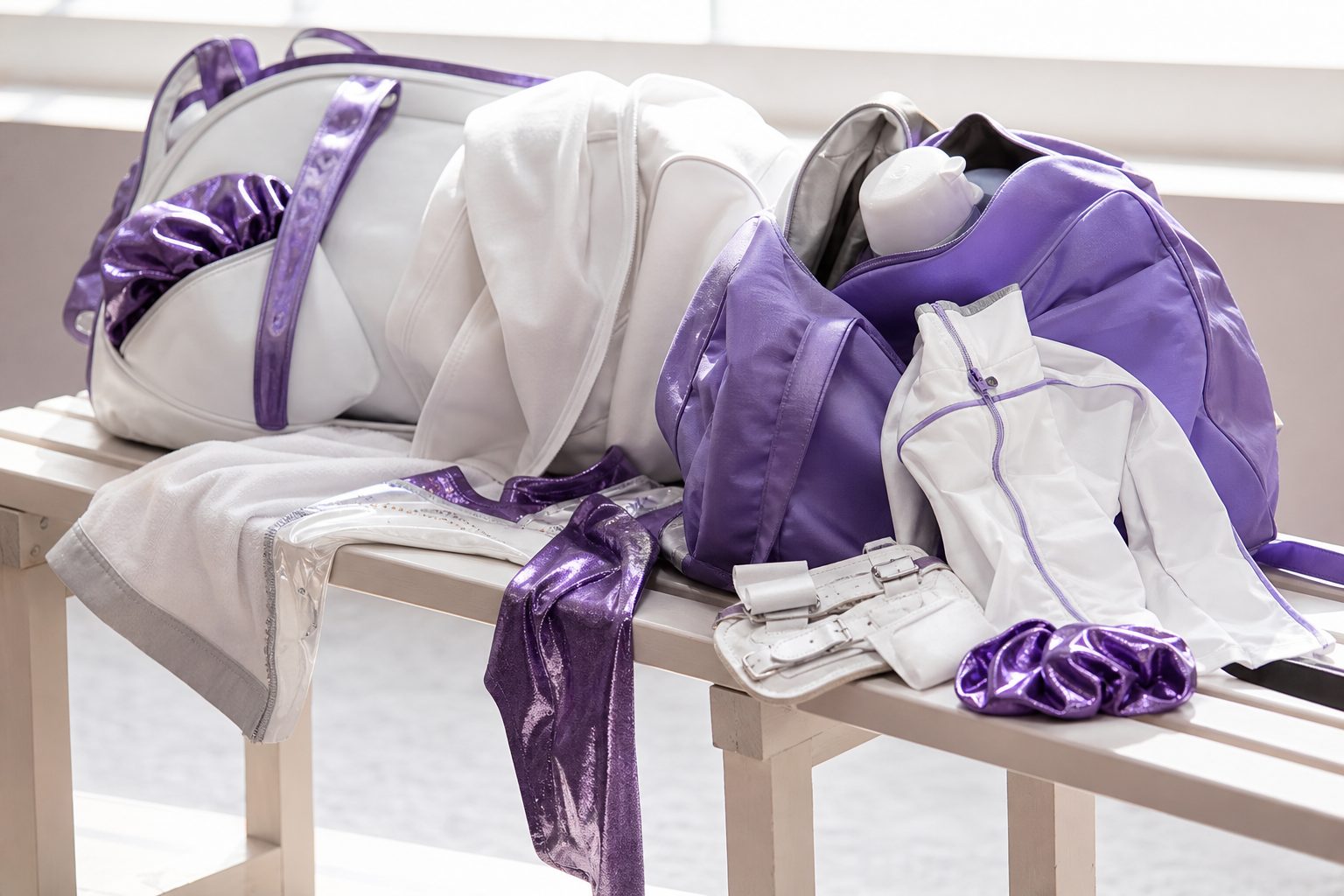
- Competition leotard tried on, checked for a split seam or a stretched leg elastic
- Warm up jacket and pants, correct size, team matching
- Two pairs of grips per bar worker, with the backup already broken in
- Wrist supports, dowels and spare grip straps
- Beam shoes and floor slippers if your athletes use them
- Hair supplies: the exact ties, pins and spray, doubled
- Athletic tape, prewrap, blister care, scissors and a small first aid kit
- Chalk, since some hosts limit what is available at the warm up stations
- Music files for floor, on a device and as a backup on a second device
A grip that tears in a Saturday warm up with no broken in spare is a scratched bar routine. That is the single highest value item on this list.
Arrival day timeline and the parent communication you send once
Build the timeline backward from the first march in. If your session marches in at 8:30am, open stretch is likely 7:45, doors to athletes maybe 7:30, hotel departure 7:00, breakfast 6:15, wake up 5:45. Write those times out and hand them over rather than describing them.
Then send one document. One. It should carry the full weekend schedule with addresses, the hotel name and your room block confirmation, the rooming list, admission prices and whether the venue is cash only, the curfew, your cell number and the assistant coach's, the uniform and hair standard, and a clear line on where parents may and may not be during warm ups. Send it seven days out, then resend the same document two days out with nothing changed but the subject line.
Everything you answer in that document is a question you do not answer individually forty times.
Where this checklist should actually live
The reason travel week feels chaotic is rarely that gym owners do not know these steps. It is that the steps live across a coach's binder, a registration email, a group chat and someone's memory, and none of those refresh when an athlete scratches or a coach certification lapses.
VaultChalk holds the pieces in one place: entries and session assignments per meet, athlete records with medical and insurance details, fee collection tied to the athlete rather than a spreadsheet, and a parent facing view so families see the schedule and what they owe without texting you at nine at night. Set your roster and your meet up once, and travel week becomes a checklist you tick rather than a week you rebuild.
From the people who publish Chalk Line
Put every level, skill and meet entry on one roster
VaultChalk keeps skill progression, level placement, meet entries and season fees in a single record your coaching staff can open from the floor, with a parent view that answers the question before it reaches you at the chalk bowl.
Read also
How much does one competitive gymnast really cost my gym per season once I count everything?
Coach hours, floor time, meet entries, insurance and equipment wear all attach to each athlete. Here is how to build a defensible cost per athlete figure before you set tuition.
What does a judge see in the first ten seconds of a compulsory beam routine at a meet?
From the meet floor: how judging panels are seated, what deductions land earliest in a compulsory beam routine, and what coaches can realistically fix in the warm up gym.
How do I move a Level 3 gymnast to Level 4 without skipping the skills USAG actually requires?
A working walkthrough of the USA Gymnastics Development Program compulsory structure, what a Level 4 routine demands, and how to build a promotion checklist your staff can sign off on.