field report
What does a judge see in the first ten seconds of a compulsory beam routine at a meet?
From the meet floor: how judging panels are seated, what deductions land earliest in a compulsory beam routine, and what coaches can realistically fix in the warm up gym.
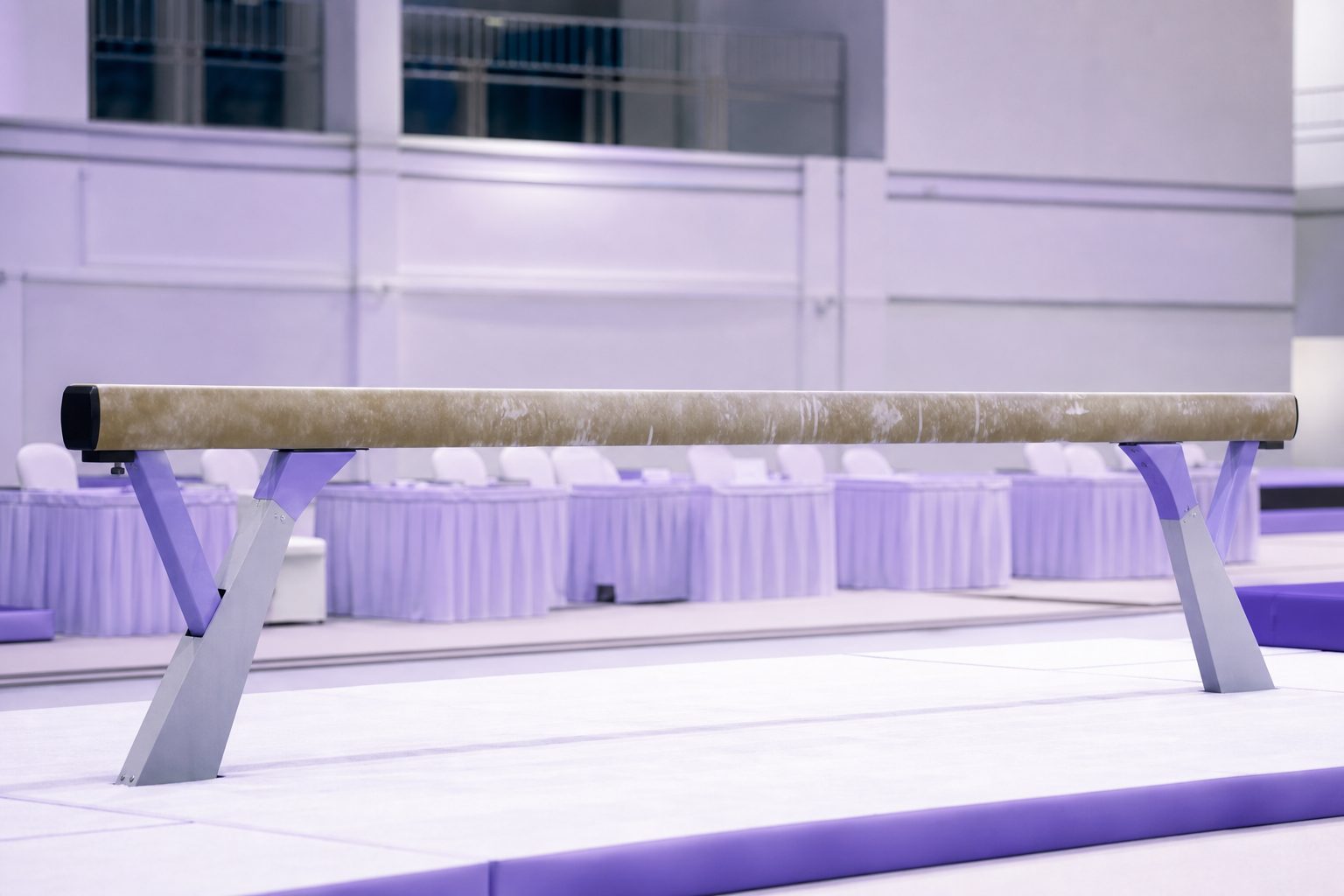
In the first ten seconds of a compulsory beam routine, a judge is not watching your athlete's best skill. She is watching the salute, the mount, the first thing that has to hold still, and whether the athlete has arrived on the beam in control or is already chasing her balance. Those seconds routinely carry more deduction than any single element later in the exercise, because they compound: a shaky mount produces an adjusted foot, which produces a hesitation, which produces a rhythm break, and each of those is a separate deduction from a separate category.
Put plainly, the early deductions are almost all execution and body position. Bent knees, flexed feet, an arm that never fully reaches, a head that drops, a hold that never becomes still. They are small, they are individually cheap, and there are a lot of them.
This is a field report from the meet floor, not a rulebook. Deduction values and routine texts vary by the compulsory program you compete under and by the current cycle, so verify specifics in the code and text your meet is judged from. What follows is what the panel is actually doing while your athlete is on the apparatus.
How a panel is seated and what each judge is watching
At a typical sanctioned compulsory meet, beam is judged by two officials seated at a table roughly at the side of the apparatus, angled so they see the length of the beam rather than looking straight down it. That angle is deliberate. From the side, a judge sees hip and shoulder alignment, leg separation, and whether a handstand or a leap reaches its shape.
The two judges score independently, then compare. If their scores fall within an allowed range, the score is averaged. If they differ by more than that range, they confer and resolve it before the score flashes. That is why the wait sometimes stretches: it is usually two judges reconciling, not one judge deliberating.
Both judges track the same routine but tend to catch different things, which is the point of a panel. One may be sharper on amplitude and shape, another on line and finish. Neither is watching your face or your athlete's warm up. They start when she salutes.
What the salute actually signals
The salute is a contract. It says the athlete is ready and the judge may begin. Until the athlete salutes and the judge acknowledges, nothing counts. Athletes who mount before acknowledgment create confusion and occasionally cost themselves the beginning of the exercise. Teach the pause. It costs nothing and it settles the athlete.
Keep reading: How do I move a Level 3 gymnast to Level 4 without skipping the skills USAG actually requires?
Mount and first connection: where early deductions cluster
Compulsory beam mounts are usually simple by design, which means they are judged strictly. There is nowhere to hide in a straight jump to a squat or a step on mount. The judge is looking for a fully extended body position at the top of the jump, straight legs, pointed feet, and a controlled arrival with the hips over the base of support.
The deductions that cluster here are the ones coaches watch a thousand times and stop seeing.
- Feet not fully pointed on the push off or in the air
- Knees bent when the text calls for straight legs
- Arms not fully extended, or elbows soft in the reach
- Head position dropped, breaking the intended line
- An extra step or an adjustment of the hands or feet on arrival
- A hold position that never becomes genuinely still
Each is a small deduction. Six of them in the first ten seconds is not small. And most are correctable in the gym without changing a single skill.
The other early cost is the first connection. Compulsory texts specify which elements connect directly. If your athlete pauses between them to gather herself, the judge takes a rhythm or connection deduction on top of whatever balance deduction she already took. One wobble becomes two deductions.
Amplitude, rhythm and the deductions coaches under train
Amplitude is height and range of motion, and it is under trained because it is uncomfortable. A leap that is technically split but only just off the beam scores worse than the same leap driven higher. A relevé that is barely a relevé reads as a flat position. Judges see amplitude instantly because they see hundreds of the same routine in a session and yours sits against that mental scale.
Rhythm is the second under trained category. A compulsory routine has an intended tempo. Girls who rush the easy parts and stall before the hard parts telegraph nervousness and take rhythm deductions for it, even when every element is completed. The fix is not more skill work. It is running the routine at tempo with a coach counting out loud, over and over, until the pacing is muscle memory rather than a decision made under stress.
The third is the finish. Athletes stop working the moment the last skill lands. The judge is still watching. Extension, a held finish position and a clean salute are cheap points sitting on the table.
Keep reading: Should I run my cheer program under USASF rules or stay with a school league schedule?
Falls, spotting and the difference in scoring impact
A fall from the beam is a single, large, flat deduction, and it also stops the clock in the athlete's head. The athlete has a defined amount of time to remount, usually announced or timed by the meet, and the routine continues from where it left off. Coaches who understand this coach the remount as its own trained skill: get up, breathe, salute if the meet requires it, resume at tempo.
Spotting is categorically different. If a coach touches the athlete during a skill, that skill generally receives no credit, which is far more expensive than a fall in most cases because it removes the value of the element as well as taking a deduction. The practical rule on the competition floor is simple: do not touch unless you are preventing an injury. Injury prevention always wins. Score never does.
A useful way to frame it for your athletes: a fall costs you a chunk of the score and you keep the routine. A spot can cost you the element entirely. So fight for the beam, and if you are going down, go down cleanly and get back up fast.
What the flash score conversation with a judge can and cannot cover
Most meets allow a coach to approach the judges table under defined conditions, and the boundaries are narrow. What you can raise is a matter of fact or arithmetic. What you cannot raise is a matter of opinion.
| You can reasonably ask about | You cannot argue |
|---|---|
| A math or posting error on the score sheet | The size of an execution deduction |
| A deduction applied for a routine text requirement, seeking clarification | Whether a wobble was really that big |
| Whether a specific required element was recorded as performed | The judge's overall impression |
| A score posted for the wrong athlete or wrong level | Comparison to another gym's athlete |
Approach the table calmly, at a permitted moment, with the score sheet in hand and a specific question. Ask what she saw at the mount, not why the score was low. Judges will almost always answer a specific technical question and will almost never revisit a judgment call. Also know that many meets require inquiries to follow a formal procedure and a deadline, so read the meet packet before you need it.
See how VaultChalk handles this for gymnastics and cheer gyms
Warm up gym adjustments that actually change a score
By the time you are in the warm up gym, you cannot teach a skill. You can absolutely fix presentation. Spend your minutes on this sequence rather than on repetitions of the hardest element.
- Two full routines at competition tempo on the low beam, coach counting audibly. You are setting pacing, not correcting technique.
- Mount only, five times, with a held finish. Nothing after the mount.
- Feet and knees. One pass focused solely on point and straight. This is where the cheapest points live.
- The one connection that is fragile, drilled as a connection rather than as two skills.
- Dismount landing, three times, sticking the shape and holding it before the salute.
- One full routine on the competition height beam if you get it, then stop. Stop before fatigue starts producing errors the athlete will remember.
Do not introduce a correction the athlete has never heard in the warm up gym. A new cue thirty minutes before competition adds a thought, and a thought on beam is a wobble.
Turning the score sheet into next week's practice plan
Collect the score sheets, do not just record the score. Then, for each athlete, write the deductions into categories rather than as a list of moments. Over three meets, patterns appear that a single sheet never shows.
The categories worth tracking per athlete are: mount, balance and adjustments, body shape including feet and knees, amplitude, rhythm and connections, dismount, and presentation. If one athlete loses most of her points in body shape and another loses hers to balance, they need entirely different weeks. Shape is drilled cold with slow repetitions. Balance is drilled with volume, on beam, with fatigue in the legs.
The gyms that improve compulsory beam scores fastest are almost never the ones adding difficulty. They are the ones who noticed that eleven of their fourteen Level 4 girls lost points at the mount, and spent three weeks on mounts.
Keeping the record so the pattern is visible
All of that depends on having the score sheets, the deduction notes and the skill progressions in one place per athlete, meet after meet, instead of scattered across a binder in a coach's bag and a photo on someone's phone.
VaultChalk tracks skills by level and holds meet entries and results against the same athlete record, so a coach can see across a season where an individual keeps losing tenths and parents can see the progression their daughter is actually making. Log the sheet on the drive home, and next week's practice plan writes itself.
From the people who publish Chalk Line
Put every level, skill and meet entry on one roster
VaultChalk keeps skill progression, level placement, meet entries and season fees in a single record your coaching staff can open from the floor, with a parent view that answers the question before it reaches you at the chalk bowl.
Read also
How do I move a Level 3 gymnast to Level 4 without skipping the skills USAG actually requires?
A working walkthrough of the USA Gymnastics Development Program compulsory structure, what a Level 4 routine demands, and how to build a promotion checklist your staff can sign off on.
Should I run my cheer program under USASF rules or stay with a school league schedule?
All star and scholastic cheer differ in credentialing, season length, cost per athlete and travel load. Here is how the two paths compare for a gym deciding where to put its teams.

What do I get wrong when I collect competition fees from parents before meet entries close?
Meet entry deadlines are firm and mostly nonrefundable. These are the fee collection errors that leave a gym owner covering entries out of pocket, and the policy language that prevents them.