comparison
Should I run my cheer program under USASF rules or stay with a school league schedule?
All star and scholastic cheer differ in credentialing, season length, cost per athlete and travel load. Here is how the two paths compare for a gym deciding where to put its teams.
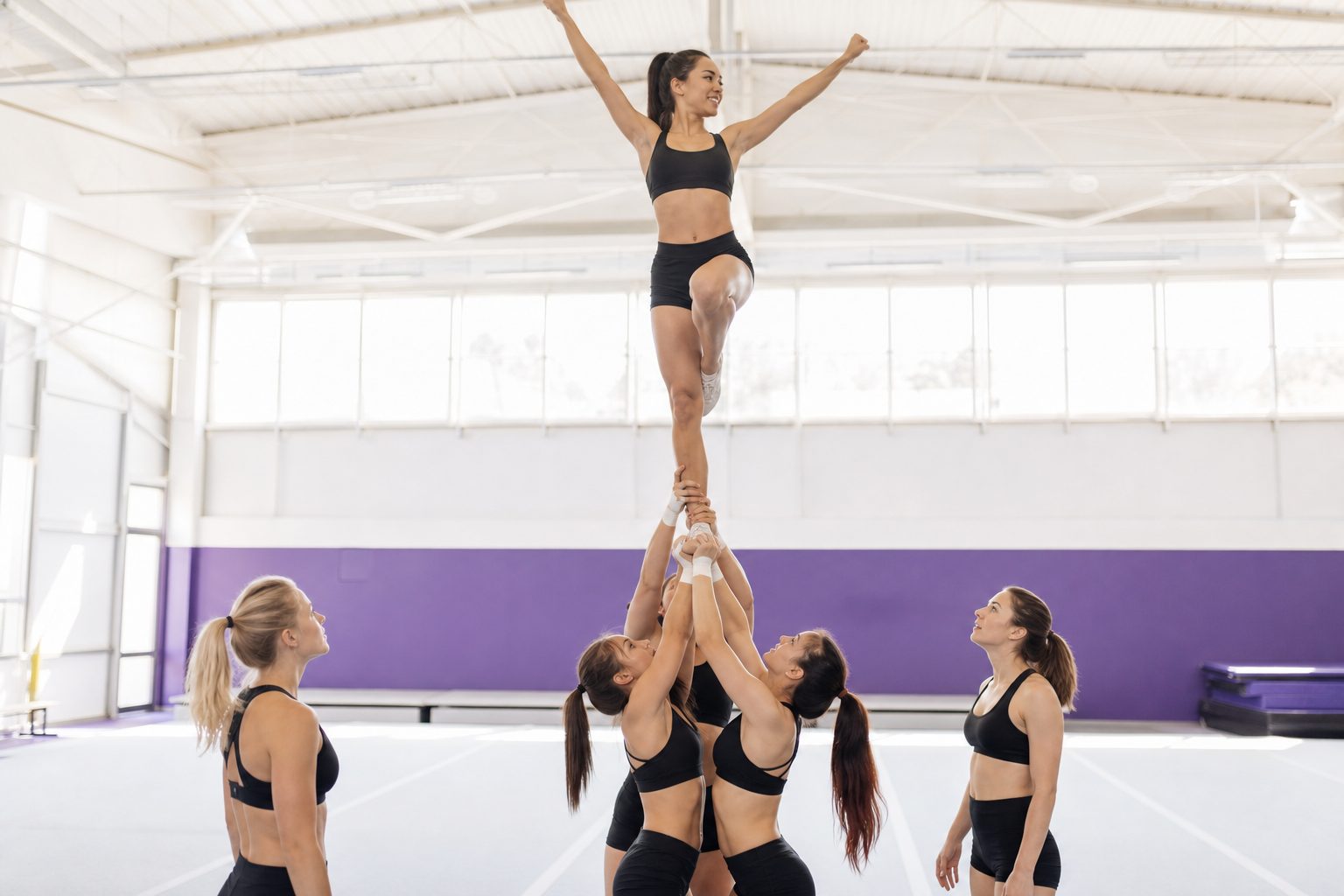
Run under USASF rules if you want your own teams, your own season and revenue you control, and stay with school league work if you want steady facility relationships and low family cost with a much thinner margin. Those are the two businesses, and they are genuinely different businesses, not two flavors of the same one.
All star cheer under the United States All Star Federation makes you the program owner. You register the gym, credential the coaches, place athletes on levels, buy choreography, pick events and collect every dollar. Scholastic cheer through a school and its state athletic association makes you a service provider. The school owns the roster, the calendar and usually the uniform, and it competes under National Federation of State High School Associations spirit rules rather than USASF ones.
Gyms that succeed at both run them as separate lines with separate coaches and separate pricing. The ones that struggle try a single squad that does both, then find out in November that two calendars want the same eleven girls on the same three weekends.
What USASF membership and credentialing require of a gym
USASF membership operates at three levels: the gym or club itself, each coach, and each athlete. All three carry annual membership. The gym registration is what makes you eligible to send teams to USASF sanctioned events, and event producers check it at registration.
Coaches carry a separate obligation. USASF runs a credentialing program tied to the level a coach is instructing, with testing on the tumbling and stunt rules that apply at that level, plus a background screening requirement for adults working with athletes. Credentials are level specific, which matters operationally: a coach credentialed for lower level work cannot simply be moved onto your Level 4 team midseason because someone quit.
That single constraint drives more staffing pain than anything else in all star. Build your credential coverage a level above where your teams currently sit. Two coaches credentialed at each level you run is the practical minimum, because one is a single point of failure and single points of failure take December off.
What the scholastic side requires instead
School programs answer to the state athletic association, which adopts NFHS spirit rules and sets its own coaching education, concussion training and background check requirements. If you are contracting into a school as a choreographer or a tumbling coach, you are usually working under the school district's own volunteer or contractor screening process, and you may need the association's coaching course regardless of what certifications you already hold.
Two different rulebooks means two different skill ceilings. A stunt or tumbling pass that is legal at a given all star level may not be legal under high school rules, and vice versa on some surfaces and formations. Coaches who cross between the two need to know which book they are standing in, every single practice.
Keep reading: What do I get wrong when I collect competition fees from parents before meet entries close?
Season calendars side by side and where they collide
All star runs roughly November through April, with the heaviest competition weight from January to March and end of season championships in late April and early May. Practices ramp in summer, teams are placed in the spring or early summer, and choreography lands in late summer.
School cheer runs the school year. Sideline for football in fall, sideline for basketball through winter, and where the state sanctions competitive cheer, a qualifying and state series that typically lands in the same winter window as your all star peak.
| Month | All star | Scholastic |
|---|---|---|
| May to July | Tryouts, placement, tumbling camps | Quiet, spring tryouts, summer camp |
| August to October | Choreography, cleaning, first events | Football sideline, weekly games |
| November to December | Competition season opens | Basketball sideline begins, comp season opens in many states |
| January to March | Peak events, bids, travel | Districts, regionals, state |
| April to May | Championships, next season tryouts | Season closes, spring tryouts |
The collision is January through March, and it is total. An athlete on both tracks will face a school competition and an all star event on the same weekend at least twice, and the school almost always wins that argument because it controls her eligibility.
Cost per athlete: uniforms, choreography, competition fees, travel
Build this from your own numbers rather than from an industry figure, because your rent, your travel radius and your event mix move the total more than anything else. Here is the structure, with illustrative assumptions clearly marked as assumptions so you can swap in your real ones.
Assume a Level 2 all star team of twenty athletes, six local or regional events, one two night hotel event, and a routine choreographed by an outside choreographer for a flat fee of $4,000 plus travel.
- Choreography: $4,000 across 20 athletes is $200 each. Add $600 of choreographer travel and lodging and it becomes $230.
- Music: a licensed custom mix at, say, $700 for the team is $35 each.
- Uniform and warmups: assume $450 per athlete for uniform, shoes, bow, practice wear and a warmup, paid once, with a two season uniform life.
- Event entry: assume $95 per athlete per one day event and $145 for the two day. Six events at $95 is $570, plus $145, so $715.
- Memberships: athlete membership plus any event producer registration, assume $80.
- Travel: one hotel weekend at two nights, family paid, assume $400 in rooms and fuel per family.
That totals roughly $1,910 per athlete for the season before tuition, and tuition is the part that funds your gym. If you charge $185 a month for team training across ten months, the family is at about $3,760 for the year. Show them that number in June, not in pieces across nine invoices.
The scholastic version is smaller and mostly not yours. The school covers or subsidizes uniform and entry, families pay a fee that in many districts sits in the low hundreds, and your revenue is a contract for choreography, tumbling instruction or open gym time. A choreography contract at $2,500 and a weekly tumbling block at $900 a month for four months is $6,100 from a squad of twenty, versus roughly $37,000 in tuition alone from an all star team of the same size.
That gap is why gyms chase all star. The counterweight is that all star risk sits entirely on you, and school revenue arrives whether or not you filled a roster.
Keep reading: What does SafeSport actually require of my gym, and who on my staff has to be trained?
Coach certification and background check obligations in each path
Track these as a compliance calendar, not as a folder. Each item has an expiration date and each expiration can bench a coach at an event.
- USASF gym membership renewal date.
- Each coach's USASF membership and credential, recorded by level.
- Background screening date and its renewal cycle for every adult on the floor.
- CPR and first aid expiration for at least one adult present at every practice.
- School district or state association clearances for anyone working scholastic contracts.
- Concussion education, where your state requires it for youth sport coaches.
Set a single reminder ninety days ahead of the earliest expiration in each category. Credentials that lapse in December cost you a coach at the exact moment you cannot replace one.
Division and level structures parents will compare
All star teams are placed by age division and by skill level, with tumbling and stunt difficulty defined level by level in the USASF rules. A parent reads that grid and understands immediately what her daughter can and cannot do this year. It is transparent, and transparency cuts both ways: it also makes every placement decision visible and arguable.
School competitive cheer divides mainly by school enrollment size, sometimes with a game day versus competitive split. Skill is not the divider. A small school squad with three strong tumblers can win a division that a technically deeper program cannot enter.
Parents will compare these systems and conclude one of them is unfair. Get ahead of it by explaining, at your parent meeting, that all star measures difficulty and school measures school size, so a state title and a Level 3 first place are not the same object.
See how VaultChalk handles this for gymnastics and cheer gyms
Insurance and facility implications of each route
All star raises your own exposure. You own the training environment, the spotting decisions, the equipment and the supervision, so your general liability and participant accident coverage need to reflect the levels you actually run. Tell your carrier the truth about your highest level. A policy written for a recreational tumbling gym is not a policy for a Level 4 program.
Scholastic contracts shift some exposure to the district but rarely all of it. Read the indemnification clause in the contract before you sign, and confirm whether you are covered as an additional insured when you are coaching on their floor with their athletes. If you are hosting their squad in your gym, you are back to your own policy regardless of whose team it is.
Running both without cannibalizing your own rosters
It is workable with three rules held firmly.
First, publish the conflict policy before tryouts, in writing, naming which commitment wins on a doubled weekend. Second, price the crossover athlete honestly rather than discounting her into a schedule she cannot keep. Third, do not put the same coach on both a school squad and an all star team competing in the same window. She will be in two buildings on one Saturday and both programs will feel shortchanged.
Then track it. Rosters, level placements, credential expirations, event entries and fee status across two calendars is more than a spreadsheet holds gracefully, and the failures show up as a coach without a current credential at check in or a family invoiced for an event her daughter scratched from.
Deciding, and keeping track of the decision
Pick the path that matches the risk you can carry and the buildings you already have. Then write down the calendar, the compliance dates and the per athlete cost you just calculated, and keep them somewhere your staff can see without asking you.
VaultChalk was built for exactly that: level placement and skill progress by athlete, event entries with fees attached, and a parent facing view so families stop emailing you to ask what is due. If you are running two seasons under two rulebooks, one shared record is the difference between a busy season and a chaotic one.
From the people who publish Chalk Line
Put every level, skill and meet entry on one roster
VaultChalk keeps skill progression, level placement, meet entries and season fees in a single record your coaching staff can open from the floor, with a parent view that answers the question before it reaches you at the chalk bowl.
Read also

What do I get wrong when I collect competition fees from parents before meet entries close?
Meet entry deadlines are firm and mostly nonrefundable. These are the fee collection errors that leave a gym owner covering entries out of pocket, and the policy language that prevents them.

What does SafeSport actually require of my gym, and who on my staff has to be trained?
The federal Safe Sport Act and NGB policy set training, reporting and one on one interaction rules. Here is who they cover in a typical gym and what records you must keep.

How did one gym rebuild its team levels after losing half a roster to a rival program?
A close look at how a mid size competitive program restructured tryouts, training groups and communication after a defection year, and which choices actually held the next season.